Peer-Reviewed Articles
-
2026. “Preferences or Principles? The Limits of Public Support for the Rule of Law.” European Journal of Political Research.With Taylor K. Chewning, Amanda Driscoll, Jay N. Krehbiel, and Michael J. Nelson.
[Show abstract]
When will individuals support government noncompliance with the written law? A bedrock principle of the rule of law is that politicians who fail to comply with written law will face political consequences. Drawing on survey experiments fielded in two consolidated democracies, we introduce the noncompliance penalty, the loss of public support for a government action that contravenes the law. The results show that citizens do penalize governmental noncompliance with the law. However, we find that this penalty decreases if government noncompliance advances the policy interests of favored protest groups, and mixed evidence that this penalty increases with professed support for the rule of law. Perhaps surprisingly, our results suggest that citizens with the strongest commitment to the rule of law can become most accepting of noncompliance if it advances their policy goals. These findings have important implications for understanding whether the public will punish politicians who disregard the formal letter of the law.
-
2025. “Trust in the Judiciary and Partisan Reactions to Judicial Checks: Evidence from Argentina.” British Journal of Political Science 55: 1–24.
- Co-recipient of the 2025 Neal Tate Award for best paper on judicial politics presented at the 2024 Southern Political Science Association annual meeting.
[Show abstract]
How do citizens evaluate the judiciary in the wake of politically salient rulings? I argue that judicial checks on the government shape citizens’ attitudes about judicial institutions at large, but these effects are driven by instrumental considerations, namely partisanship. In particular, my account suggests that judicial checks—as specific instances of interbranch conflict—provide citizens with instrumental information that shapes their beliefs about the broader judiciary. Thus, I hypothesize that court rulings limiting the government’s power will undermine support for the judiciary among individuals aligned with the incumbent, but increase support among opposition sympathizers. I test these expectations by exploiting the timing of the Rizzo rulings in Argentina (enacted by a lower court and the Supreme Court), which invalidated a highly salient judicial reform promoted by the government in 2013. Using data from a survey fielded before and after the court rulings, I show that the decisions significantly decreased government supporters’ trust in the judiciary, while opposition supporters increased their trust only following the Supreme Court ruling. Moreover, suggestive evidence provides support for the mechanism proposed by my account—that judicial checks expose citizens to information that is primarily instrumental. This paper contributes to our knowledge of the determinants of public support for judicial institutions involved in inter-branch conflicts.
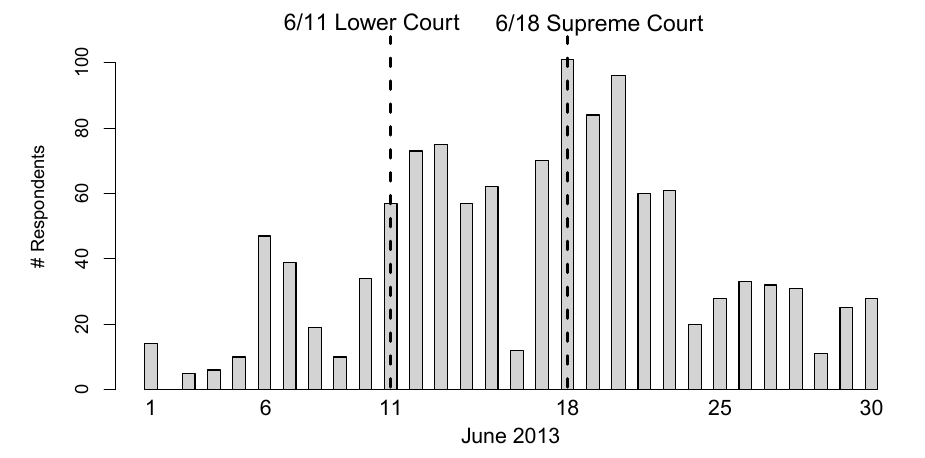
Distribution of respondents of Latinobarómetro respondents by date of interview 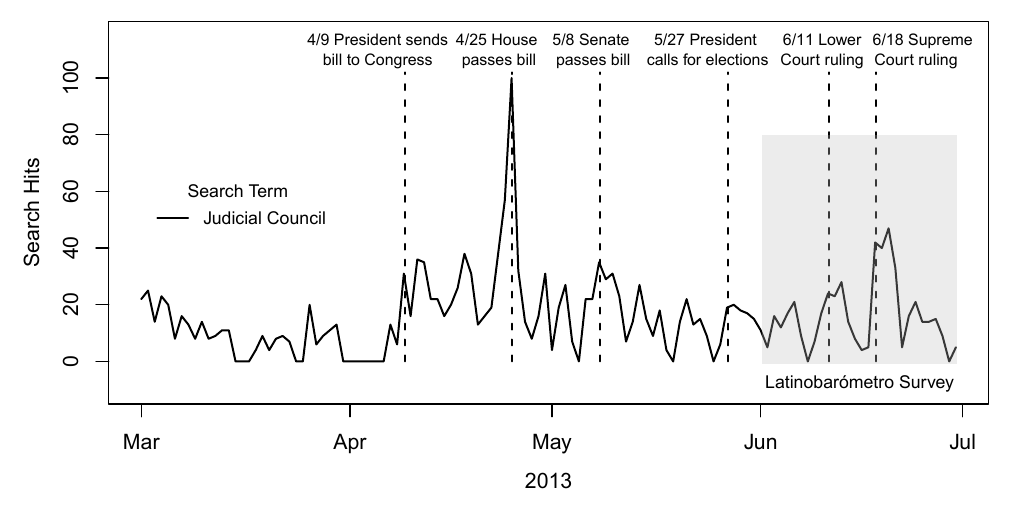
Google Trends search interest in the Judicial Council 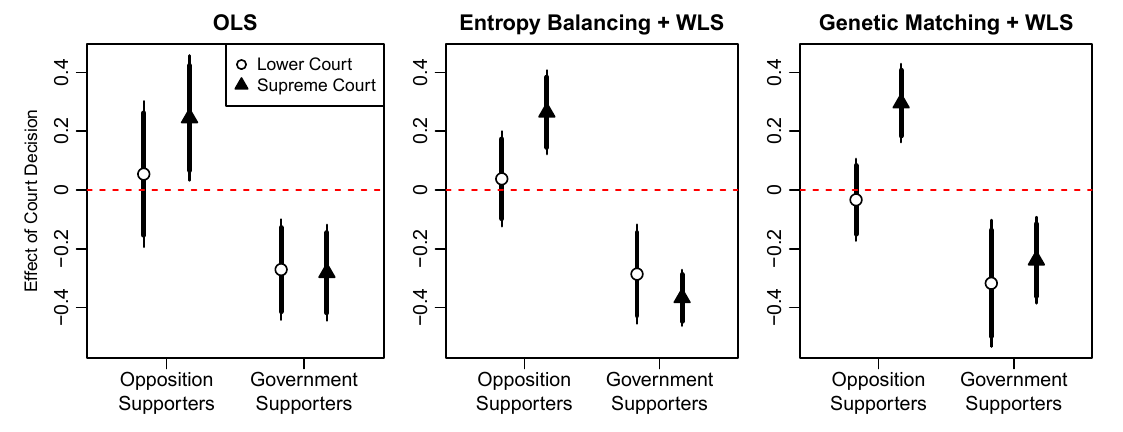
Partisan reactions to the Court rulings: Government supporters decreased their trust in the judiciary after the Rizzo decisions and opposition supporters increased their trust 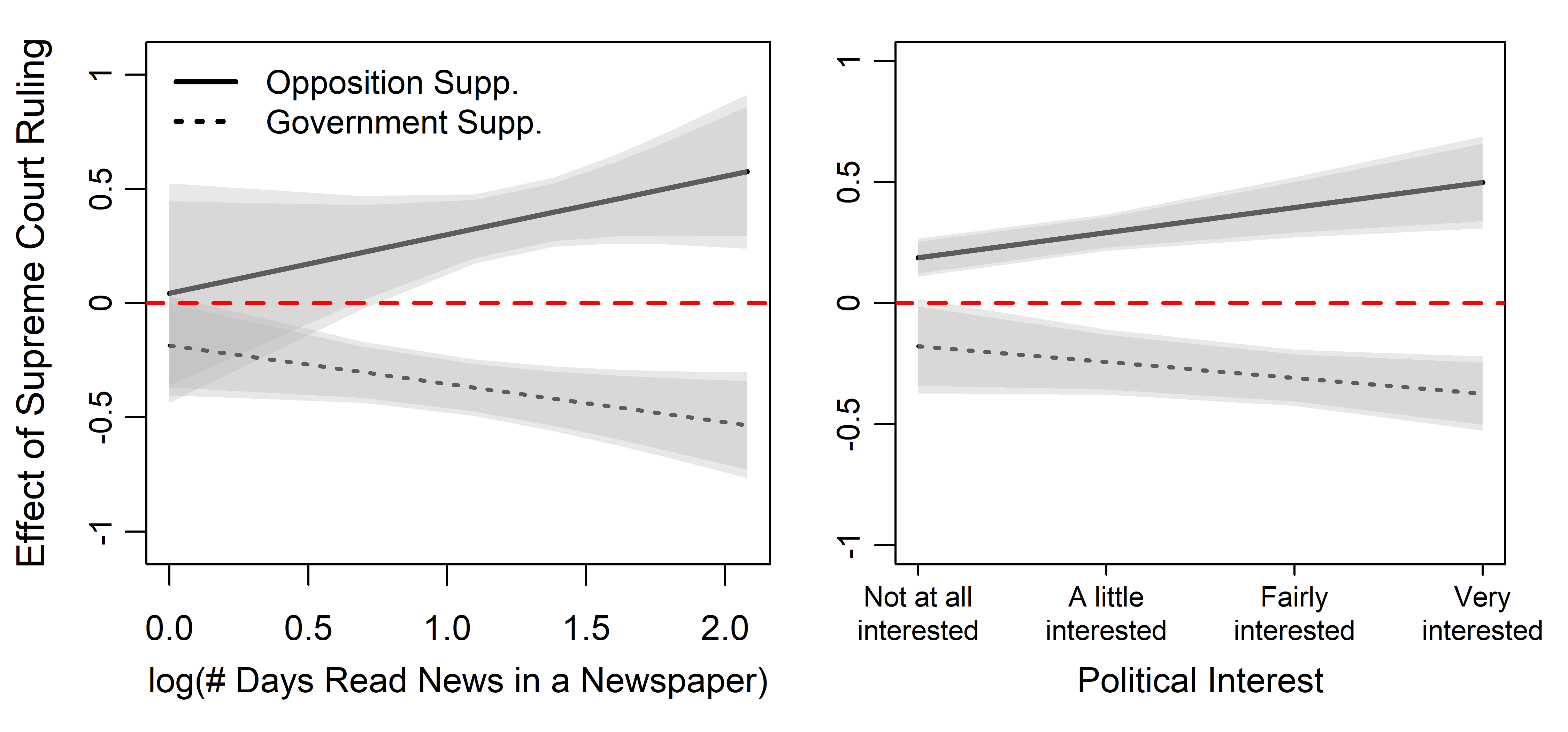
The partisan effects are larger among better informed and more politically interested respondents [Appendix][Replication Materials] -
2025. “Awareness of Executive Interference and the Demand for Judicial Independence: Evidence from Four Constitutional Courts.” Journal of Law and Courts 13(1): 122–147.With Taylor K. Chewning and Amanda Driscoll.
[Show abstract]
Awareness of courts has long been theorized to engender enhanced support for judicial independence, but this is a logic that works only under the best of circumstances. We argue that interbranch politics influences what aware citizens know and learn about their court, and we theorize how awareness interacts with individual-level and context-dependent factors to bolster public endorsement of judicial independence in previously unappreciated ways. We fielded surveys in the United States (US), Germany, Poland, and Hungary, countries which diverge in the extent to which the environments are hospitable or hostile to high courts, and whose publics vary greatly in both their awareness of courts and perceptions of executive influence with the judiciary. We suggest that in hospitable contexts, awareness correlates with support for judicial independence, but said association depends on perceptions of executive influence. In hostile contexts where executive interference is common, more aware citizens are more apt to perceive this meddling, and although it might undermine trust in the judicial authority, it does not diminish their demand for judicial independence. Together, these findings underscore that public awareness and support for judicial independence are greatly informed by the political environment in which high courts reside.
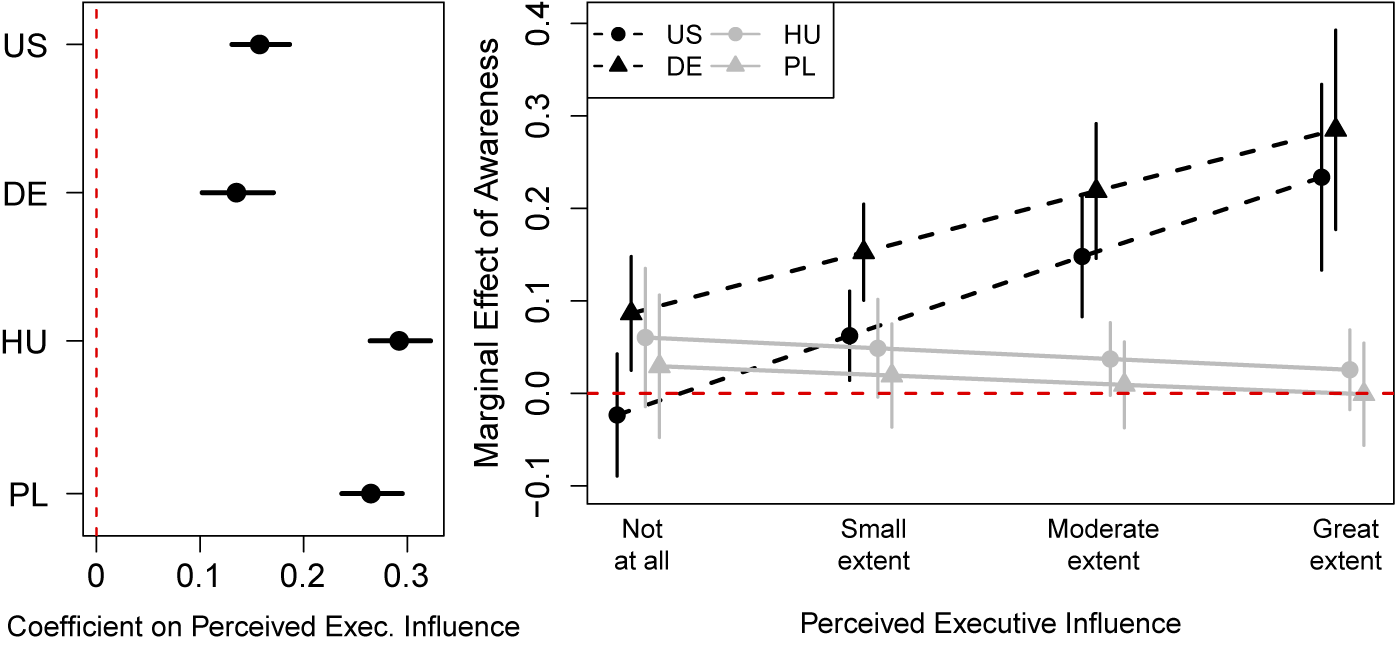
Effect of Perceived Executive Influence and Awareness on Demand for Judicial Independence. [Appendix][Replication Materials]
Chapters in Edited Collections
-
2023. “Public Support and Compliance with High Courts Around the World.” In Research Handbook on Law and Political Systems, edited by Robert M. Howard, Kirk A. Randazzo, and Rebecca A. Reid. Edward Elgar Publishing, pp. 213–235.With Amanda Driscoll.
[Show abstract]
Lacking both the ‘purse and the sword’, how do high courts ensure incumbents will obey judicial decisions? A vast literature in comparative law and courts suggests that widespread popular beliefs in courts’ legitimacy work as a public enforcement mechanism for judicial institutions facing threats of noncompliance. In this chapter, we review the research at the intersection of public support for courts and incumbents’ compliance with court orders. We first summarize two prominent theoretical models of judicial independence, describe their logical consequences for public evaluation of noncompliance, and suggest directions for future research. Then, we turn to the scholarly literature on compliance with judicial decisions and identify five questions that the empirical measurement of compliance must answer. Next, we elaborate what these challenges imply for public awareness, comprehension, and evaluation of (non)compliance. We conclude by outlining several opportunities for future research.
[Preprint] -
2021.”Los Estados (des) Unidos: Federalismo y descentralización en los tiempos de pandemia.” In Covid-19 y Estados en acción, edited by Esteban Nader and Marie-Christine Fuchs. Bogotá: Tirant lo Blanch and Konrad-Adenauer-Stiftung, pp. 278–317.With Alexandra K. Artiles and Amanda Driscoll.
[Show abstract]
How did the federal and state governments respond to the 2020 pandemic? The history of U.S. federalism indicates that the federal government centralized in times of crisis by commandeering the states and setting specific economic and health precedents. In this chapter, we argue that the federal government decentralized during the health and economic crisis caused by covid-19 disease and encouraged states to set their own economic and health standards. In addition, we explore the federal government’s decentralized response to the pandemic and trace the efforts of the 50 states in mitigating the crisis. We find that there is wide variation in their responses, variation that demonstrates the “price of federalism”: states offered their citizens different responses to the health and economic crises and exacerbated the inequities that preceded the pandemic era.
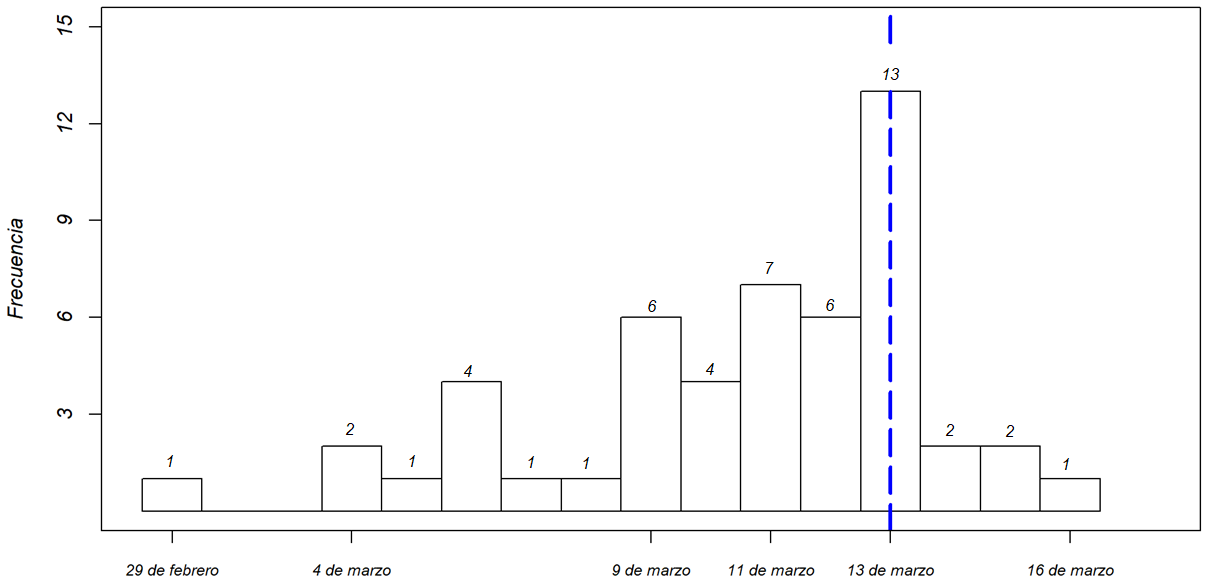
States’ Emergency Declarations Preceding Federal Declaration 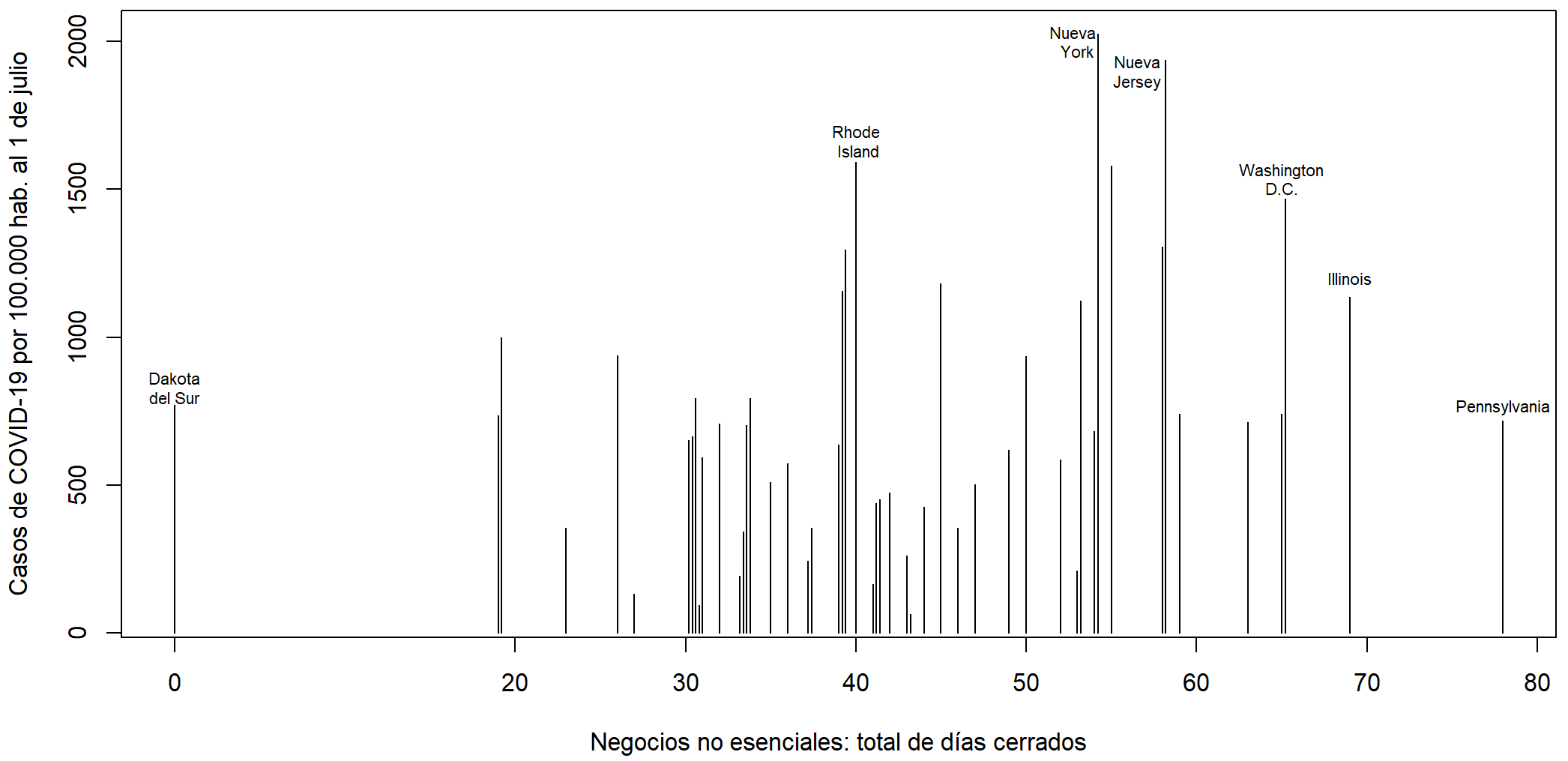
COVID-19 Cases Per 100,000 on July 1, by Days of Non-Essential Business Closure [Print] [PEX blog]
Working Papers
- “Support for Courts in the Wake of Controversial Decisions: Evidence from an Abortion Ruling in Argentina” (with Matheus Zanetti). Invited to revise & resubmit at Journal of Law and Courts.
[Show abstract]
How do citizens judge courts following controversial rulings? A consolidated scholarship in judicial politics shows that policy and partisan preferences explain citizens’ support for courts. However, little work examines how individuals evaluate judicial institutions when their policy and partisan sources of support are in tension. We argue that these attitudes are most relevant when courts enact controversial decisions, and we derive competing theoretical expectations from both partisan and policy-based models of support for judicial institutions in the wake of court rulings. We test these hypotheses by exploiting the timing of the Argentinian Supreme Court’s “FAL” decision, a high-profile ruling that decriminalized abortion for rape victims. Our design allows us to (1) estimate the causal effects of a controversial ruling on public support for courts in a real-world setting, and (2) examine the extent to which policy or partisan sources of support prevail in the aftermath of the FAL ruling. We find that the judicial decision increased respondents’ willingness to curb the Court but did not affect public trust in the institution. Moreover, our evidence is broadly consistent with partisan-based models of support, but the results are mixed and not fully conclusive. Our findings call into question the stability of judicial legitimacy in the developing world and have important implications for interbranch politics.
-
“Policy Agendas, Effective Lawmaking, and Women’s Issues in State Legislatures” (with Andrew Ballard, Mackenzie Dobson, Craig Volden, and Alan Wiseman). Under Review.
[Show abstract]
We leverage transformer-based text classification to accurately assign more than 1.6 million bills that were introduced into state legislatures to 18 different policy areas. We then introduce Issue-Specific State Legislative Effectiveness Scores (ISLES), for legislatures that convened between 2009-2019 in 48 states. We show which issues gain the most attention in legislatures, and which are the most gridlocked, as well as systematic patterns in the issues over which experts or ideological centrists are most successful. We also demonstrate that female lawmakers disproportionately sponsor bills engaging with Civil Rights, Education, Health, and Welfare: policy areas that are conventionally categorized as being “women’s issues.” We find that bills in these issue areas are more gridlocked than other policy areas, on average. However, in chambers approaching gender parity, women’s issue bills—especially those proposed by women—are more likely to advance into law.
- “Judicial Checks and Public Support for Democratic Backsliding.”
[Show abstract]
Under which conditions can separation-of-powers institutions mobilize public opposition to undemocratic behaviors? Building on coordination models of judicial review, I argue that courts can serve as focal points for citizens’ coordination against democratic transgressions by incumbents, but only under certain conditions. Judicial checks on undemocratic leaders are most likely to coordinate public backlash where courts frame their decisions on procedural (rather than substantive) grounds, and when the ruling comes from a credible source. I test my theoretical expectations with a pair of original survey experiments in Argentina. In the first experimental module, respondents evaluate three hypothetical scenarios in which a co-partisan provincial governor enacts an undemocratic action via executive decree. After reading about the decree, respondents learn that a provincial Supreme Court has invalidated the governor’s action. I then randomly vary the rationale for the judicial check—highlighting a procedural or substantive violation. Following each scenario, I measure respondents’ agreement with the ruling and their expectations about copartisans’ reactions to governmental noncompliance. In the second experiment, I randomly vary the partisan composition of the invalidating court and measure respondents’ credibility assessments of the judicial decisions. I find that procedural framings significantly shape respondents’ expectations about copartisans’ reactions, consistent with the coordination mechanism, while substantive framings generate stronger agreement with the ruling itself. Moreover, the credibility of judicial checks depends on the perceived partisan alignment between the court and the incumbent: out-party courts elicit the lowest credibility assessments, yet in-party courts are not perceived as significantly more credible than mixed ones. The chapter contributes to the emerging literature on public tolerance for democratic backsliding and the role of counter-majoritarian institutions in sustaining democracy.
- “Courts, Judicial Independence, and the Mobilization of Public Support.”
[Show abstract]
Why do unpopular and politically constrained courts render independent decisions? I propose a theory that seeks to explain how public support can enhance courts’ independent behavior in environments assumed to undermine judicial power. My argument posits that judicial independence depends on courts’ capacity to mobilize publics in their favor vis-á-vis incumbents, and identifies two conditions that help courts maximize their mobilization capacity—even if they lack widespread popularity. I suggest that courts can best mobilize support (1) where citizens’ evaluate courts “instrumentally,” and (2) where elites can credibly threaten the integrity of judicial institutions. In this paper, I focus on the first condition and test a number of observable implications using a survey experiment conducted on a sample of Argentinian respondents. The experiment exposes respondents to a ruling from Argentina’s Supreme Court that either invalidates or validates a salient government policy. I find that the Court ruling striking down the incumbents’ policy increases respondents’ perception that the Court is opposed to the government. However, the invalidation of the policy does not significantly affect respondents’ support for the Court’s independence.
-
“Court Interrupted: Institutional Legitimacy in the Face of Democratic Backsliding” (with Amanda Driscoll and Michael Nelson).
[Show abstract]
-
“Public Support for Gender Diversification of the Judiciary” (with Eugenia Artabe).
[Show abstract]
Under which conditions do citizens support gender diversification of courts? We argue that public preferences about gender diversification are highly contextual, and propose an account that identifies two conditions that increase or decrease public pressure for diversification during a Supreme Court nomination process—visibility of the court’s gender imbalance and the political stakes of the nomination. We develop a set of observable implications of our argument and provide preliminary quantitative and qualitative evidence from recent Supreme Court nominations in Argentina. We then detail a conjoint experiment we will conduct to formally test our hypotheses on a sample of Argentinian respondents in Fall 2025.
Works in Progress
-
“District Magnitude, Intra-Party Competition, and Party Unity in Proportional Systems: Evidence from Argentina” (with Claudio Robelo Guzmán).
-
“Does Increased Access to Justice Improve Public Evaluation of Judicial Institutions?”
-
“How Do Rules for Judicial Appointment Affect Court Performance and Judicial Independence?”

